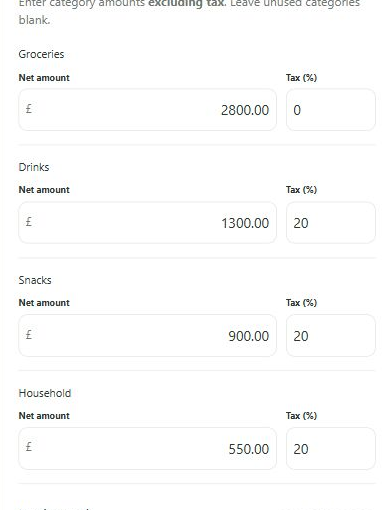
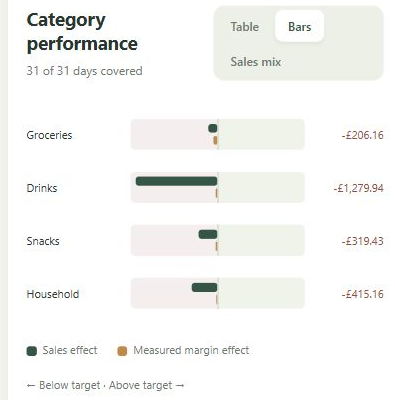
Many owners want to understand the money held in stock without maintaining a detailed quantity record for every individual product. Know My Shop takes a category approach: start with a stock valuation, record purchases and sales in the same categories, and use margin assumptions to estimate how the stock value changes between counts.
Start with a valuation you can explain
For an illustrative category, suppose the stock has a retail value of £5,000 excluding sales tax and an assumed gross margin of 30%. The implied cost value is £3,500: 70% of that net retail value. This is a category valuation method, not a list of the exact purchase cost of every unit on the shelves.
Sales tax must be separated from the retail value before reducing it by the margin. Category assumptions also need care when goods have different tax treatment or very different margins. A convenient average is only useful when it is a reasonable basis for the stock being valued.
Follow the value between counts
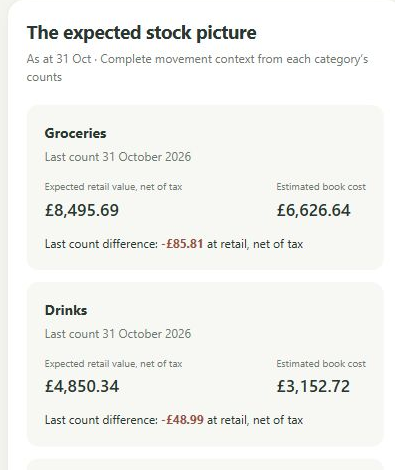
Purchases add stock value; sales reduce the estimated retail value held. Know My Shop uses the recorded category information to project a stock value from the latest count. That gives you something to review between physical valuations without asking you to record every individual product movement.
It does not tell you that there are twelve tins of a particular brand left. It does not create an exact reorder list, track expiry dates or replace physical stocktaking. Its purpose is to connect the broad value of stock with the other management figures you record.
Let later counts challenge the estimate
When you enter another dated stock valuation, compare it with the projection. A difference is a reason to investigate the assumptions and records. Missing purchases, discounting, waste, pricing changes, counting mistakes and losses can all affect the relationship. The report does not identify the cause automatically.
Appropriately dated opening and closing counts, together with purchases, can support count-adjusted gross-profit reporting for a period. Even then, the cost valuation depends on the method and margin assumptions used. The distinction between an estimate and a count-adjusted figure should stay visible.
Choose the level of detail you actually need
If your main question is which exact items to reorder, you may need an item-level inventory system. If you want a category view of money tied up in stock and the relationship between buying and selling, this lighter approach may be a useful fit.
A practical app for the person running the shop.
Keep your existing till. Use your own categories. Build your management picture from familiar daily totals.
See how Know My Shop worksWant a clearer picture of your own shop?
Keep your existing till and explore what category-level management information could do for your business.
Register your interest