Retail associations help members improve the way they trade. Alongside advice on purchasing, regulation and customer service, there is an opportunity to strengthen a fundamental business skill: understanding where the money goes and what each part of the shop contributes.
An owner may have a modern till, a card terminal and accounting software, yet still struggle to explain why gross profit fell short of expectations.
The information exists in different places. Bringing it together into a manageable routine is the purpose of Know My Shop.
For an association, promoting this approach offers members a practical benefit: regular control of cash, stock and category performance, using figures they already collect.
Connect the records with the decisions
A till report shows sales. Supplier invoices show purchases. Card statements and bank records show money moving. Physical assessments establish the stock actually held.
Individually, these records answer different questions. Used together, they help an owner understand the business.
Maintaining detailed records for every product requires continuing work: receiving deliveries, updating costs, recording adjustments and checking quantities. For a shop selling hundreds or thousands of low-value items, that can be a substantial undertaking.
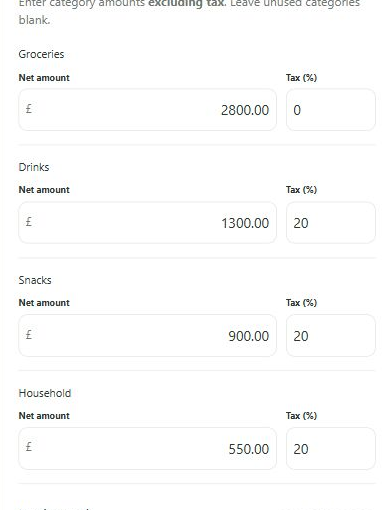
Know My Shop works at category level. Members use familiar headings from their sales reports, allocate purchases to those headings, record cash movements and enter periodic stock assessments.
They keep their existing till and accounting arrangements. The management routine gives the records a more immediate purpose.
Explain the profit shortfall
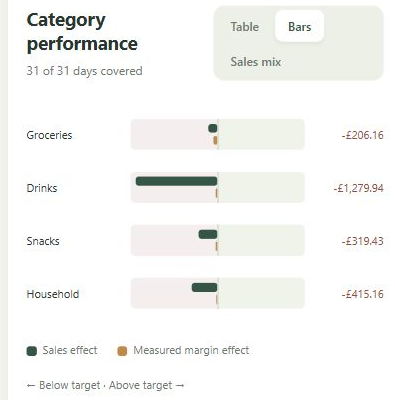
Knowing that sales were below target is useful. Knowing how much gross profit was lost through lower sales—and how much through a lower margin—is more useful still.
Consider a category with a monthly sales target of £20,000 and an expected gross margin of 30%. The expected gross profit is £6,000.
Actual sales reach £18,000. At the expected margin, these sales would produce £5,400 of gross profit. Lower sales have therefore caused a £600 profit shortfall.
Purchases and the closing stock assessment establish an achieved margin of 27%. Gross profit is £4,860, giving a further £540 shortfall from margin.
| Reason for the gross-profit shortfall | Amount |
|---|---|
| Sales below target | £600 |
| Margin below expectation | £540 |
| Total shortfall | £1,140 |
These differences call for different decisions.
The sales shortfall prompts a review of demand, availability, promotions and targets. The margin shortfall prompts questions about buying prices, selling prices, discounts, wastage and stock losses.
An association can use this simple distinction to help members assess performance in pounds of contribution, as well as pounds of takings.
Give stocktaking an immediate reward
Between stocktakes, Know My Shop calculates an estimated stock value from the previous assessment, subsequent purchases, sales and margin assumptions.
The owner can regularly consider whether that figure remains reasonable.
An estimate that rises while the shelves appear unchanged deserves attention. Wastage, damage, discounting and theft can leave less stock or profit than the calculation anticipates.
Entering a physical stock assessment updates the category contribution calculation. Differences become visible in the achieved margin and gross profit for the period.
This gives stocktaking an immediate management benefit. The owner receives a clearer picture of performance and a reason to investigate discrepancies, while the system establishes a fresh starting point for the next period.
Estimates remain clearly distinguished from figures based on stock assessments, with the valuation basis visible.
Follow takings through to the bank
Cash and banking controls complement the performance reports.
Daily reconciliation compares the cash counted with the amount expected after allowing for sales, card takings, the opening float, refunds, payments and money removed for banking.
Banking checks connect cash deposits and card settlements with money actually received. Supplier-account checks connect purchases, payments and outstanding balances.
These checks give unexplained differences a place to appear and a record to investigate. Small discrepancies can be followed over time rather than disappearing into the next trading day.
Build better plans from trading experience
Regular category records also provide a basis for planning.
Members can compare periods, review sales and margin trends, and project future contribution. Historical trading and seasonal adjustments help make expectations more relevant to the shop.
The owner can then consider the profit implications of a promotion, a price change or a different sales mix. Forecast assumptions remain visible, so projections can be reviewed as fresh results and stock assessments become available.
Category contribution is shown before general overheads. Members can add overheads when useful without having to complete a second set of financial accounts before gaining management insight.
A practical opportunity for the association
An association can introduce this approach through demonstrations, short workshops and voluntary member trials.
A workshop could follow one trading day from till totals to the closing cash check, then use a monthly category report to explain the separate effects of sales and margin. Members would leave with a repeatable method they could apply to their own shops.
A member trial can assess the effort required, the questions answered and the actions owners take as a result. Those findings provide a sound basis for deciding how widely to promote adoption.
The association’s contribution is education and practical access. Know My Shop provides the routine that helps members put that education to work.
Helping owners understand their cash, stock and category contribution gives them a stronger basis for managing the businesses on which their livelihoods depend.

A practical app for the person running the shop.
Keep your existing till. Use your own categories. Build your management picture from familiar daily totals.
See how Know My Shop worksBring this approach to your members.
Tell us about your association and your interest in a practical demonstration or member trial.
Discuss a member demonstration