Know My Shop helps independent retail owners monitor cash, stock and category performance during the year. Its purpose is to give the owner a manageable routine for understanding trading results and investigating differences while there is time to respond.
An accountant may recommend it to a client who would benefit from stronger operational control. Alternatively, a client may ask whether adopting it will interfere with their existing bookkeeping or financial reporting.
In either case, the intended relationship is straightforward: Know My Shop provides supplementary management information. The accountant retains the existing financial-accounting and tax-compliance process.
Its place alongside the accountant’s records
Adopting Know My Shop does not itself require a change to the accountant’s software, chart of accounts, posting procedures or year-end process. It does not automatically post journals into another accounting system.
The client continues to provide the agreed primary records: POS reports, supplier invoices, bank statements, payment-provider statements and other supporting documents.
Know My Shop brings selected information from these sources together for management purposes. Daily sales may be entered from a till’s department totals or a Shopify category report. Purchases are allocated to corresponding categories. Cash movements and periodic stock assessments complete the relevant management picture.
The resulting reports supplement those sources. They do not establish that every business transaction has been recorded, and they should not displace original evidence merely because a management total appears reasonable.
If the accountant elects to use a particular report or export in preparing the accounts, its inputs, coverage and calculation basis can be assessed for that purpose.
Category contribution rather than complete business profit
The principal performance measure is the contribution from each sales category before general overheads.
For goods categories, the underlying calculation is:
Cost of goods sold = opening stock at cost + relevant purchases − purchase credits − closing stock at cost
Category gross profit = net category sales − cost of goods sold
Purchases and stock values must use a consistent cost basis, with appropriate treatment of associated costs, transfers and other adjustments.
An owner can obtain useful category gross-profit information without entering rent, electricity or every small business expense. Their absence means that the report is before those overheads.
Missing purchases belonging to the category have a different consequence: they can distort its cost of sales and gross profit. Completeness therefore matters for the category and period being assessed, even though the system does not require a complete set of business accounts.
Service categories require appropriate treatment of direct costs. Costs consumed in delivering a service are distinguished from consumables purchased but still held for future use.
Where only selected overheads are recorded, a further result is described as contribution after recorded overheads, with its coverage stated. It is not presented as complete net profit.
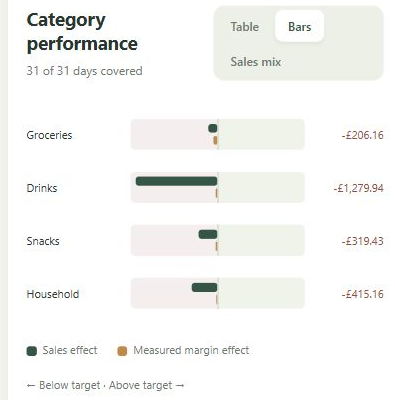
Separating sales performance from margin performance
A gross-profit shortfall can arise because sales were below expectation, because the achieved margin was lower, or through a combination of the two.
Know My Shop separates these effects in monetary terms.
For example, budgeted category sales of £20,000 at a 30% margin imply £6,000 gross profit. Actual sales of £18,000 at an achieved margin of 27% produce £4,860.
Using the budget margin to measure the sales effect, and actual sales to measure the margin effect:
| Gross-profit variance | Calculation | Effect |
|---|---|---|
| Sales effect | (£18,000 − £20,000) × 30% | −£600 |
| Margin effect | £18,000 × (27% − 30%) | −£540 |
| Total variance | £4,860 − £6,000 | −£1,140 |
This distinction supports a more useful advisory conversation. Sales performance may prompt a review of demand, availability or targets. Margin performance may prompt investigation of buying prices, pricing, discounts, wastage, damage and stock losses.
These are gross-profit effects. They do not, by themselves, explain the movement in the business’s final net profit.
Stock estimates and the value of physical assessment
Between stocktakes, closing stock is estimated from the previous assessment, subsequent purchases, sales and margin assumptions.
The estimate gives the owner a figure to review for reasonableness. A growing calculated stock balance that is inconsistent with what appears to be on the shelves deserves attention.
Recording a physical stock assessment updates the contribution calculation. A closing cost valuation below the estimate increases calculated cost of sales and reduces gross profit. The effect becomes visible in the category’s achieved margin.
This gives stocktaking an immediate management purpose: it updates the trading result and provides a fresh basis for subsequent estimates.
The valuation method remains important. Where cost is derived from a retail valuation using an assumed margin, that cost retains the assumption. A physical assessment strengthens the evidence about stock held; it does not automatically establish an exact acquisition cost.
Stock dates, category coverage and valuation assumptions should therefore be considered when reviewing a contribution report. Missing information should remain identifiable rather than being treated as zero.
Cash, banking and supplier controls
Daily cash reconciliation compares the physical closing count with the amount expected from the opening float, sales, non-cash tenders and recorded cash movements.
Every movement through the drawer matters. A small cash expense may be recorded simply as a payment for reconciliation purposes, even where the owner does not complete a detailed overhead allocation.
Banking controls follow cash removed for deposit and card takings through to money received, allowing for timing and charges. Supplier-account checks connect invoices, credits, payments and opening balances.
These controls can highlight unexplained differences. For example, a payment without the corresponding purchase entry may leave an unexpected supplier-account balance. Agreement of the bank balance alone does not establish that all invoices have been recorded.
The reconciliations support investigation; they do not certify that every sale was recorded or identify the cause of every discrepancy.
Why VAT remains necessary
Know My Shop does not calculate or submit VAT returns. VAT nevertheless matters because cash movements and trading values use different bases.
For a straightforward VAT-registered business with full input-tax recovery, consider goods bought for £72, including £12 recoverable VAT, and sold for £120, including £20 VAT.
The management calculation uses £100 revenue and £60 cost, producing £40 gross profit. The corresponding gross receipt and purchase payment remain £120 and £72.
VAT is therefore needed to:
- connect gross source-document amounts with net trading values;
- calculate category margins on a consistent basis;
- distinguish gross cash movements from costs and income;
- interpret retail stock values that include VAT.
Only recoverable purchase VAT is excluded from cost. Irrecoverable VAT remains a cost. The management basis must reflect the client’s registration and recovery position; VAT should not automatically be stripped from the purchases or sales of a non-registered retailer. Recovery restrictions and special schemes require particular care. HMRC guidance on VAT recovery
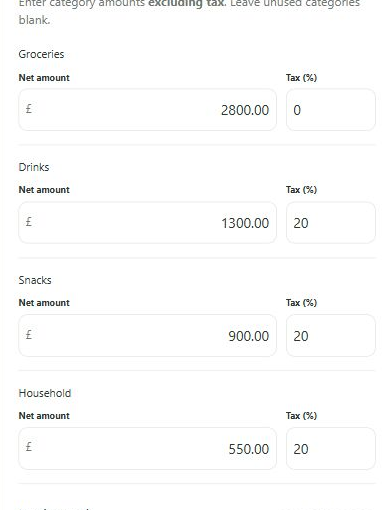
Mixed-rate categories also require an appropriate breakdown or allocation. A single default percentage may be insufficient. Any approximation used for management reporting should be explicit.
Recording net, VAT and gross amounts does not amount to maintaining a complete VAT account. Selected management entries may omit expenses, tax adjustments or other information required for a return. The accountant’s established records, scheme treatment and compliance procedures remain responsible for that work.
The boundary with statutory digital records
Know My Shop’s supplementary purpose does not determine how a client might subsequently use its data.
If an accountant chooses to incorporate an export into the client’s statutory digital-record process, the relevant completeness, recordkeeping and digital-link requirements must be considered. HMRC distinguishes supplementary information from the required electronic account and sets requirements for transfers within software maintaining that account. HMRC VAT Notice 700/22, sections 3.1–3.2.1
Any such use should be an explicit decision, with an agreed process. It is not a prerequisite for the owner obtaining management value from the system.
A practical role in the advisory relationship
For a client seeking greater control, an accountant can help establish sensible categories, margin expectations, stock-valuation assumptions and a consistent reporting basis.
For a client already using Know My Shop, its reports provide additional context for discussions about performance and unexplained differences. Differences from the accounting records can be examined through timing, scope, classification and valuation, rather than assuming the two systems must always produce identical results.
The objective is a better-informed owner who reviews trading during the year, understands the contribution from each category and investigates discrepancies promptly.
The accountant retains the complete financial-accounting process; the owner gains a repeatable way to understand and control trading between accounting reviews.
A practical app for the person running the shop.
Keep your existing till. Use your own categories. Build your management picture from familiar daily totals.
See how Know My Shop worksExplore the approach with a retail client.
Ask about using Know My Shop as supplementary management information alongside your existing accounting process.
Ask about Know My Shop