Your shop can be busy without earning the gross profit you hoped for.
Sales may be below target. Discounts may be reducing what you earn. Wastage, damage and theft may be taking their share. Changes in buying prices or the mix of goods sold may also affect the result.
A total takings figure cannot explain these differences.
Know My Shop connects your category sales, purchases and stock values to show how each part of the business contributes—and where performance falls short of your expectations.
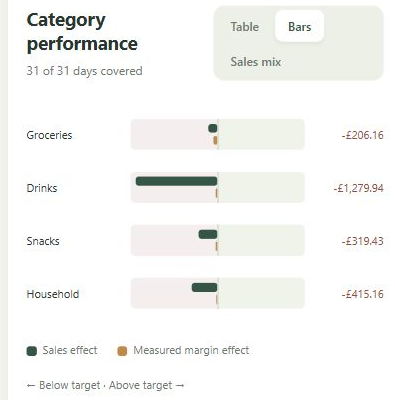
Separate the effect of sales from the effect of margin
Suppose you expect a category to sell £20,000 during a month at a 30% gross margin. Your expected gross profit is £6,000.
Actual sales reach £18,000. At the expected margin, those sales would contribute £5,400. The lower sales have therefore cost £600 of expected gross profit.
But after taking account of purchases and the closing stock assessment, the achieved margin is 27%. Gross profit is £4,860.
There are two different reasons for the shortfall:
| Effect on gross profit | Shortfall |
|---|---|
| Sales below target | £600 |
| Margin below expectation on the sales achieved | £540 |
| Total gross-profit shortfall | £1,140 |
This gives you something useful to act on.
The £600 sales shortfall prompts questions about demand, availability, promotions and sales targets. The £540 margin shortfall prompts different questions about prices, buying costs, discounts, waste and stock losses.
Seeing the two separately helps you decide where to direct your attention.
Keep an eye on the stock you should have
Between stocktakes, Know My Shop calculates an estimated closing stock value from the previous assessment, purchases, sales and the relevant margin assumptions.
That gives you a figure to review.
Does it look reasonable for what is actually on the shelves? Is the value rising even though the shop does not seem to be holding more stock? Has one category’s calculated stock become surprisingly high?
An estimate based on expected margins can become optimistic when the business achieves less than those margins. Goods may have been discounted, damaged, wasted or lost. The expected value remains in the calculation until better information explains what happened.
Reviewing calculated stock encourages you to question the picture before an unexplained difference grows.
Make a stocktake immediately useful
A stocktake takes effort. Know My Shop gives that effort an immediate management purpose.
Recording the assessed closing stock updates the category contribution calculation. The difference between expected stock and assessed stock feeds through into the profit shown for the period.
In the example above, suppose the estimated closing stock at cost was £10,000. A stocktake establishes a cost value of £9,460.
That £540 reduction increases the calculated cost of goods sold by £540 and reduces gross profit by the same amount. The category’s contribution changes from the £5,400 estimated at the expected margin to £4,860.
The stocktake has made the margin shortfall visible.
You can then investigate the practical causes. Are discounts properly reflected in pricing? Is too much stock expiring? Have supplier costs increased? Are goods being damaged or going missing? Does the category’s expected margin still reflect the business you are doing?
The figures help you identify where to look. Your knowledge of the shop helps explain why.
Understand each category’s contribution
Different categories play different roles.
A large volume of low-margin sales can dominate the takings report, while a smaller category contributes more gross profit towards the shop’s running costs.
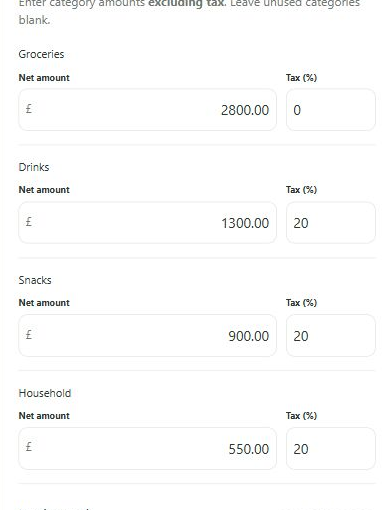
Know My Shop lets you review those contributions using the categories that mean something to your business. You can compare sales with targets, examine expected and achieved margins, and follow performance daily, weekly and monthly.
Category contribution is shown before general overheads. You can add overheads when useful, while keeping clear which costs are included.
You gain a practical view of trading without having to complete every part of the business’s financial accounts first.
Follow the money as well
Profit performance and money control belong alongside one another.
The daily cash reconciliation checks the closing drawer count against sales, card takings, the opening float and recorded cash movements. Banking checks follow money removed from the shop through to deposits and card settlements. Supplier-account checks connect recorded purchases with payments and outstanding balances.
Together, these controls help you investigate unexplained differences while the records—and the day’s events—are still familiar.
Keep your existing till and accounting arrangements. Use Know My Shop to turn the figures you already collect into a clearer understanding of your shop’s money, stock and performance.
See what your shop earns, beyond what your till takes.
A practical app for the person running the shop.
Keep your existing till. Use your own categories. Build your management picture from familiar daily totals.
See how Know My Shop worksWant a clearer picture of your own shop?
Keep your existing till and explore what category-level management information could do for your business.
Register your interest