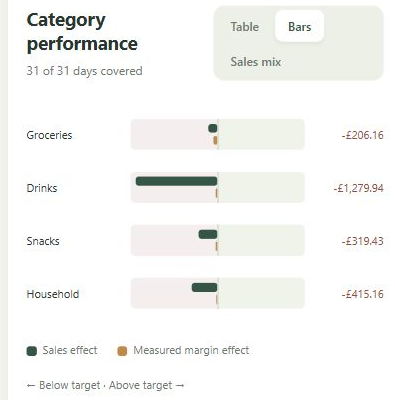
Being told that a category missed its gross-profit target is a start. Understanding how much of the gap relates to sales and how much relates to margin helps you decide where to look. Selling less than planned and earning a lower margin on the sales you made can call for different responses.
Translate the sales target into gross-profit pounds
Take an illustrative category with a £10,000 sales target and a 30% target gross margin. The gross-profit target is £3,000. If sales are £9,000, those sales would produce £2,700 at the target margin. The sales effect is therefore £300 below target. All sales figures in this example exclude sales tax.
Now suppose the category's supported, count-adjusted gross-profit figure is £2,430, equivalent to a 27% margin on £9,000 of sales. That is £270 below the £2,700 expected at the target margin. Add the £300 sales effect and the £270 margin effect: the total shortfall is £570.
Ask two different sets of questions
The sales effect might prompt a review of opening days, customer demand, availability or the mix of products sold. The margin effect might lead you to inspect buying prices, discounts, waste, stock valuations or missing records. These are possible lines of enquiry, not causes diagnosed automatically by the app.
The decomposition works in both directions. A category can exceed its sales target while lower margin offsets some of the benefit. Another can sell less but retain more of each sales pound. Looking category by category helps avoid a favourable total concealing a problem in one part of the shop.
Do not mistake an assumption for a measured result
Know My Shop can apply the target margin to recorded sales to estimate gross profit and show the sales effect. That alone cannot establish whether the actual margin was achieved. The margin effect remains unknown until the records support a count-adjusted view using purchases and appropriately dated opening and closing stock valuations.
The count-adjusted result still depends on complete entries and the category stock-valuation method. Review the basis and period coverage before treating a variance as a trading conclusion. A partial period, incomplete invoice record or weak stock assumption can change what the figures mean.
Turn the report into a conversation with the business
You do not need a different target every day. You need a consistent way to review the target you set and notice where the year is moving away from the plan. Separating the effects makes that review more specific, while keeping the judgement with the owner.
A practical app for the person running the shop.
Keep your existing till. Use your own categories. Build your management picture from familiar daily totals.
See how Know My Shop worksWant a clearer picture of your own shop?
Keep your existing till and explore what category-level management information could do for your business.
Register your interest