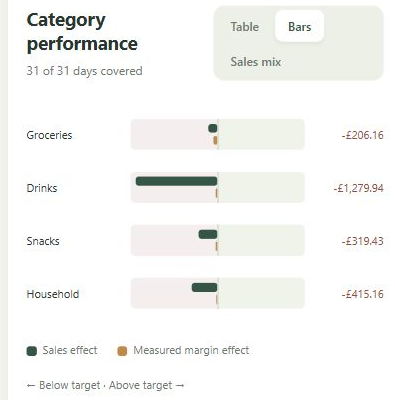
A price reduction can make a category look livelier. More customers buy, more units move and the sales total may rise. The question for the owner is what happens to the gross profit available to support the shop. A simple worked example shows why a larger sales number does not settle it.
Calculate the contribution per unit first
In this illustrative example, an item sells for £10 and costs £6. All figures exclude sales tax. Each sale produces £4 of gross profit, so 100 units produce £400. Reduce the selling price by 10% to £9, while the cost stays £6, and the gross profit per unit falls to £3.
Now suppose unit sales increase by 30%, from 100 to 130. Revenue becomes £1,170 rather than £1,000: a 17% increase. Gross profit becomes £390 rather than £400: a 2.5% decrease. More units and more revenue have left slightly less gross profit in this example.
Be clear about what grew
Unit sales and sales revenue are different measures. A claim that sales rose by 30% is ambiguous unless you know which measure it means. If the discounted price is £9 and revenue rises from £1,000 to £1,300, the implied volume is about 144.4 units. At £3 gross profit per unit, that would produce about £433.33 before other costs.
For the first example's price and cost, gross-profit break-even needs £400 divided by £3: about 133.3 units. That is roughly 33.3% more units than the starting 100. In practice, whole units mean at least 134 sales to exceed £400, assuming the same product, cost and conditions.
Use the calculation as a question, not a prediction
A promotion may still be worthwhile. It might attract new customers, clear ageing stock or encourage other purchases. Extra handling, payment charges, supplier terms and waste can also change the result. The arithmetic does not predict demand or decide the business strategy; it makes the trade-off easier to see.
Know My Shop provides category sales and gross-profit information that can help you review a trading period, with the basis of its estimates visible. It does not automatically run a controlled pricing experiment or prove that a change in sales was caused by a promotion. Record the dates and assumptions clearly, and compare like with like where you can.
Look beyond the headline
The useful question is not just whether the shop sold more. It is whether the additional business made the contribution you intended, and what you learnt for the next pricing decision.

A practical app for the person running the shop.
Keep your existing till. Use your own categories. Build your management picture from familiar daily totals.
See how Know My Shop worksWant a clearer picture of your own shop?
Keep your existing till and explore what category-level management information could do for your business.
Register your interest